

Airport arrival
Ask where to find taxis, trains, buses, baggage help, or a meeting point.
Download Pakt before you leave, prepare the languages you need, and translate when roaming, WiFi, or mobile signal is not there to help.
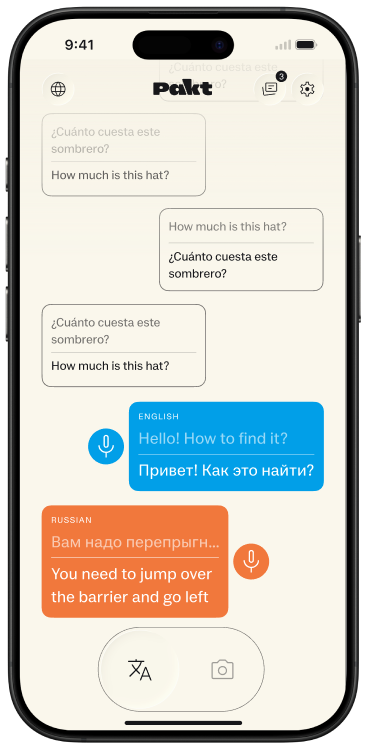
Travel reality
Most travel translation problems happen after the easy setup window has closed.
At home, WiFi is stable and you have time. After landing, the situation changes quickly. A taxi driver is waiting, the hotel desk needs a reservation name, the restaurant menu is unfamiliar, or the train announcement is unclear. That is when a travel translator should already be ready.
Pakt is built for the pre-trip workflow: install the app, choose the languages for the destination, download what is needed, and test offline translation before leaving. Once that is done, the app can help when roaming is disabled, airport WiFi is slow, or the phone has no signal.
This makes Pakt different from a translation habit that assumes every trip will have a reliable connection. Travel is full of dead zones. Preparation gives you a practical fallback for short conversations that still matter.
Ask where to find taxis, trains, buses, baggage help, or a meeting point.
Confirm the destination and ask whether card payment is accepted.
Ask about luggage, room issues, breakfast, or local directions.
Checklist
Use this as a quick travel setup routine while WiFi is good.
Travel scenarios
Give the address, ask for the meter, confirm pickup points, and handle route changes.
Ask about check-in, deposits, WiFi, room problems, luggage storage, and checkout time.
Order food, ask about ingredients, explain allergies, or request the bill.
Ask about gates, baggage, transfers, transportation, lost items, and delays.
Confirm platforms, transfer directions, ticket machines, and service changes.
Explain a simple symptom, ask for instructions, or confirm whether a product is available.
How it works
List the countries and situations where you expect to need translation.
Prepare the languages while WiFi is reliable and you have time to test.
Translate prepared languages when data is expensive, blocked, slow, or unavailable.
Offline proof
Pakt supports the trip pattern travelers actually face: prepare first, then translate later without depending on a live network request.
Voice and conversation
Travel conversations are often brief but urgent. A driver may need to hear the destination. A hotel receptionist may need to understand a room issue. A restaurant server may need to hear a dietary restriction. In those cases, voice output can be more useful than a block of text on screen.
Pakt supports voice output in 49 languages. That gives travelers a way to communicate a translated phrase without guessing pronunciation. It is not a replacement for learning local basics, but it is a practical fallback when the phrase is too important to improvise.
Translate in 100+ languages.
Hear natural voice output in 49
Travel guide
Start with your itinerary. If you are flying to Japan, Spain, France, or Italy, prepare the main destination language and the languages you use most often. If your trip crosses borders, check each country and download what you need before leaving home. The goal is to remove translation setup from the stressful parts of the trip.
Next, test real phrases. Try a taxi destination, a restaurant request, a hotel question, and a pharmacy sentence. Then turn off mobile data and repeat the same phrases. That quick practice makes the app feel familiar before you are standing in a noisy queue or asking for help with luggage.
Finally, keep expectations practical. Offline translation is strongest when you use clear, short sentences. Ask one thing at a time. Avoid slang. Confirm important details with names, addresses, maps, prices, or written numbers when needed. Pakt gives you a travel communication layer, and clear inputs make that layer more useful.
For many travelers, the best offline translator is the one that is ready before the trip starts. Pakt focuses on that preparation model so you can keep moving when connection is the weakest part of the plan.
FAQ
Because travel often puts you in places where roaming is expensive, WiFi is weak, or mobile signal is unavailable.
Download languages before leaving home or while you have reliable WiFi before the part of the trip where you need them.
Yes. Pakt is built for practical travel conversations in taxis, hotels, restaurants, stations, airports, and similar places.
No. Basic local phrases are still useful. Pakt helps when the phrase is longer, unfamiliar, or important enough to translate clearly.
Yes. Pakt supports voice output in 49 languages, depending on the selected language.
Test destination, hotel, restaurant, pharmacy, and transport phrases, then repeat them with mobile data disabled.
For prepared offline languages, Pakt translates locally on your phone and does not require cloud translation.
Most translation apps work well until your connection disappears.
That usually happens at the worst possible moment: after landing, inside a taxi, at a train station, or while trying to explain something important.
Pakt keeps working without WiFi, roaming, or mobile data.
Download your languages before you go and carry them with you anywhere you travel.
For travelers, reliability often matters more than having the most advanced translation model. The best translator is the one that still works when the internet doesn't.
More tools for smoother travel
and better conversations.
Download Pakt before your trip and translate offline while traveling. Use it in taxis, hotels, restaurants, airports, and more.